




Table of Content
Many companies begin with practical AI use cases: generating content, summarizing information, assisting with code, reviewing documents, or automating repetitive tasks. These efforts can improve individual productivity and give teams a fast way to explore what AI can do.
Enterprise performance, however, is rarely shaped by individual tasks alone. Work moves through operational workflows that involve people, systems, approvals, data, business rules, and decision points. Customer onboarding, claims processing, procurement, field operations, compliance reviews, software delivery, and support operations all depend on this broader movement of work across the organization.
That is where the limits of isolated AI use become clear. A team may complete one activity faster, while the end-to-end process still slows down because information is duplicated, systems are disconnected, approvals wait in queues, or responsibilities are spread across departments.
For this reason, AI transformation is increasingly tied to custom workflow redesign: rethinking how work should move across systems, teams, approvals, and decision points as AI becomes part of execution.
What Is a Workflow?
A workflow is the path work follows from request to outcome. It includes the steps, approvals, systems, data, responsibilities, and decision points needed to complete a business process. It also defines who acts, what information is required, where key choices are made, and how progress moves from one stage to the next.
In enterprise environments, that path often crosses many boundaries. A customer request may pass through support teams, operational platforms, managers, compliance review, financial approval, external vendors, and reporting requirements before it is resolved. Even routine activities can depend on several layers of participation before the work reaches completion.
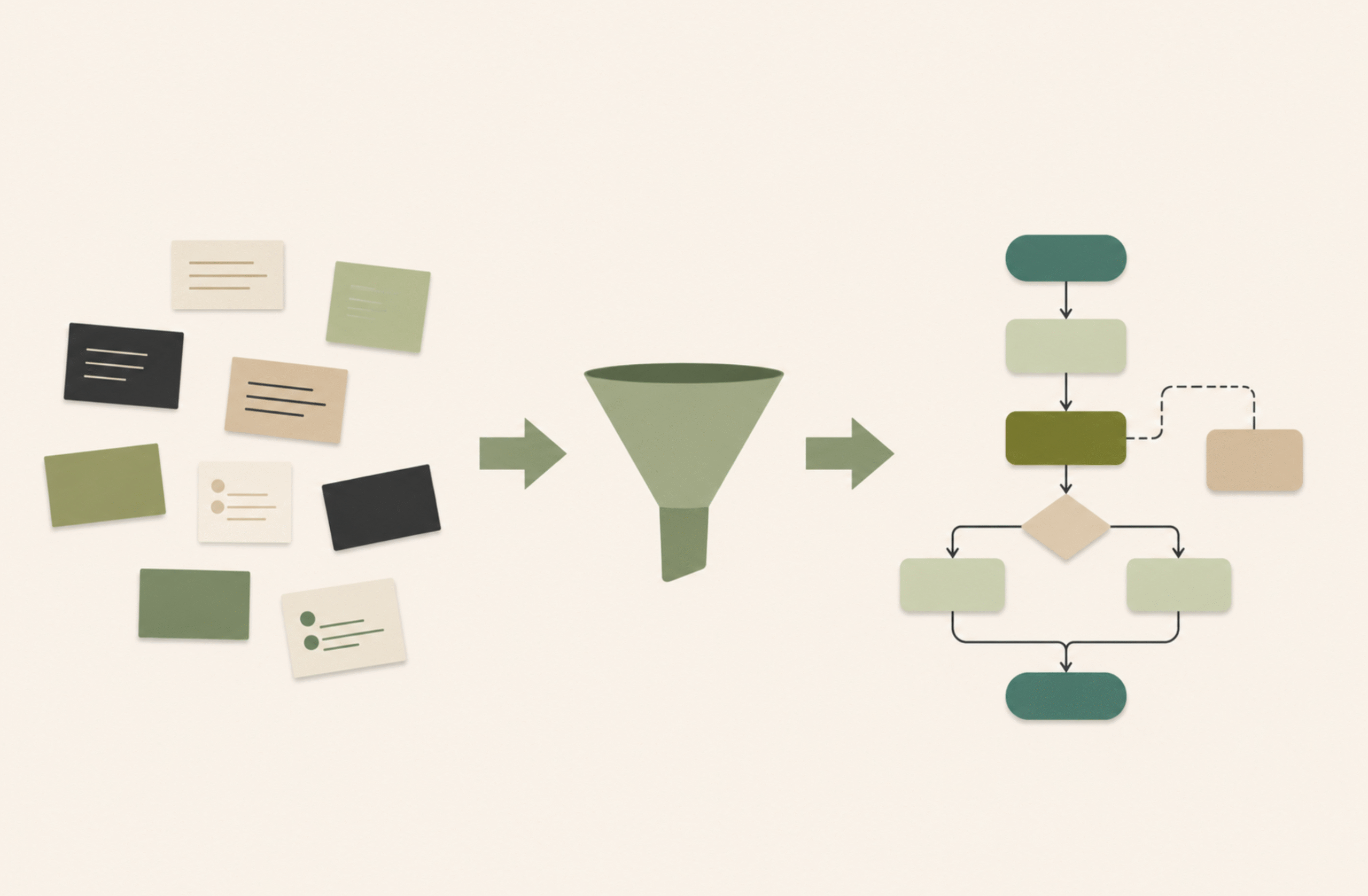
Few workflows are designed all at once. They usually accumulate over years as companies add tools, departments, policies, controls, reports, exceptions, and manual workarounds. Over time, the process begins to reflect the organization’s history as much as its current business needs.
Why AI Requires Workflow Redesign
Many enterprise processes were built for human-paced movement. Information passes from one department to another, approvals follow fixed sequences, and progress often depends on messages, meetings, reviews, escalations, and individual follow-up.
AI changes how work moves through the process. Intelligent tools can evaluate inputs earlier, retrieve information faster, interact with multiple systems, and support decisions before a request reaches the next person in line. When these capabilities enter a process built around slower handoffs, the old structure can start working against the new speed of execution.
The friction often appears between steps. A document may be summarized quickly, yet still wait for review. A request may be classified correctly, yet still move through the same approval chain. A support case may receive better recommendations, yet still depend on disconnected systems before resolution.
Workflow redesign addresses those gaps by examining the structure around the work. Leaders need to look at where delays form, where decisions should happen, which handoffs remain necessary, and how people, software platforms, and intelligent tools should interact across the process.
Organizations therefore need workflows that can support earlier analysis, faster routing, responsive escalation, and timely human review as AI becomes part of execution.
Why AI Transformation Reveals Structural Weaknesses
AI initiatives often expose problems that were already present inside the business. The first signs may appear as inconsistent data, unclear ownership, slow approvals, duplicated effort, or difficulty integrating new tools into established processes.
Many of these issues come from the way enterprise operations develop over time. Departments choose their own systems, create local procedures, add approval layers, and build informal workarounds for gaps between teams. The business keeps functioning because experienced employees know who to contact, which exception to raise, where to find missing information, and how to reconcile details that do not align.
These weaknesses become more visible as intelligent tools accelerate analysis and prepare requests earlier. Decision rights may be unclear, data ownership may be fragmented, policies may conflict, or progress may depend on manual interpretation by a small group of people.
In many cases, the problem is not a single application or department. Operational friction develops between systems, policies, approvals, and areas of ownership. A company can have modern software in several areas and still struggle if approval authority is unclear, data access is uneven, governance rules are applied inconsistently, or handoffs depend on personal knowledge without defined operating practices.
Workflow redesign therefore raises operating model questions. Leaders may need to clarify who owns each stage, where decisions should be made, which exceptions require escalation, how governance applies, and how human judgment should interact with intelligent tools.
A stronger operating foundation gives AI a better environment to work within: clearer ownership, reliable data flow, timely decisions, adaptable tooling, and defined points for human review.
Where AI Agents Make the Most Sense
AI agents make the most sense in business activities where work changes frequently, information comes from many sources, and decisions depend on context. Stable, repetitive, and highly predictable activities may continue working well with conventional automation, fixed rules, and clearly defined procedures.
Customer operations, claims handling, field services, compliance review, procurement, software delivery, and support functions often contain shifting priorities, incomplete inputs, changing requirements, and decisions that require interpretation across several stages of activity.
In these environments, the difficulty rarely comes from one activity alone. The larger challenge involves directing requests through multiple participants, maintaining continuity across systems, adapting to changing conditions, and ensuring the right person receives the right information at the right moment.
AI agents become useful when they can help manage that variability. A request may need different handling depending on urgency, risk level, customer history, operational conditions, or regulatory requirements. Intelligent tools can assist by organizing incoming material, preparing recommendations, identifying unusual conditions, guiding requests toward the appropriate route, and helping teams respond with greater consistency.
Operational fit still depends heavily on context. Some activities benefit from adaptive decision support and dynamic routing, while others continue working well with straightforward automation and stable procedures. Organizations need to identify where intelligent tools improve responsiveness, continuity, and operational performance without introducing unnecessary complexity.
Successful adoption depends on understanding how work behaves across the business: where conditions change, where interpretation is required, where delays accumulate, and where human expertise carries the greatest value.
AI-Native Execution Requires Supporting Infrastructure
As AI-enabled workflows expand across the business, companies need a technical foundation that can move data reliably, apply business rules, control access, monitor outcomes, and support consistent behavior across departments.
In many organizations, these capabilities are organized through AI platforms: shared environments that provide model access, reusable components, governance controls, monitoring, integration patterns, and development workflows for AI-enabled solutions. A strong platform layer can help teams scale redesigned workflows safely and consistently.
Enterprise applications must exchange data cleanly. Business logic needs to be available to the systems that depend on it. Approval paths, communication channels, analytics platforms, and AI tools need defined ways to interact so work can continue without relying on ad hoc connections.
Teams also need to know who can access sensitive data, which actions require review, how outcomes are evaluated, and where exceptions should be recorded. Without these controls, AI-enabled workflows can become difficult to audit, maintain, or expand.
Common integrations, security patterns, monitoring tools, data connectors, and service layers can support multiple initiatives. This helps reduce fragmentation and gives teams a stronger base for future workflow redesign.
Infrastructure decisions shape the long-term value of AI initiatives. Companies that invest in reliable data access, reusable services, governance controls, and system integration are better prepared to scale intelligent workflows consistently across the business.
AI-Native Business Operating Models
As AI becomes part of daily operations, its influence can extend beyond individual applications or workflow redesign initiatives. Work may be routed differently, approvals may happen earlier, and some operational decisions may occur before every step receives direct human review.
These changes affect how companies organize execution across the business. Activities once handled within a single department may begin involving product, operations, technology, compliance, and data functions simultaneously. Process owners may need to understand automation rules, escalation paths, model behavior, and the conditions that require human involvement.
Governance standards also become more important as intelligent tooling gains broader reach. Organizations need clear standards for data access, review requirements, approval authority, audit procedures, and escalation handling so employees understand where automated actions can proceed and where professional judgment remains necessary.
Team structures may evolve alongside these changes. Some employees may focus on validating outcomes, refining business rules, maintaining supporting platforms, or monitoring how redesigned workflows behave over time. Coordination across functional areas becomes more important because operational performance increasingly depends on how effectively these groups operate together.
AI-native business operating models emerge when decision structures, process ownership, technical controls, and human expertise function as part of a coordinated framework that can adapt as business conditions change.
Organizations best prepared for this transition will build clear approaches for assigning work, evaluating decisions, supervising systems, and applying human expertise where it creates the greatest value over time.
The Enterprise Transformation Opportunity
As companies redesign workflows and modernize operating practices around AI, the amount of transformation work expands quickly. Every business function introduces its own constraints, regulatory expectations, system dependencies, approval requirements, and operational realities that must be addressed carefully as intelligent tooling becomes part of day-to-day activity.
This creates demand for teams with AI skills that can work across multiple disciplines at once. Workflow redesign, software engineering, systems integration, data management, process supervision, and AI implementation often need to evolve together so new capabilities can operate reliably inside real business environments.
The work also becomes highly contextual. A customer operations initiative may require different controls, escalation handling, and data practices than a compliance workflow, field service platform, or procurement environment. Success depends on understanding how each business function operates, where delays accumulate, how information moves, and where human expertise must remain closely involved.
Krasamo helps organizations navigate this transition through AI engineering teams that support custom workflow redesign, intelligent automation, systems integration, and the development of adaptable operational solutions aligned with evolving business conditions.