Table Of Content
Essential AI Skills for Agentic Orchestration
The era of incremental technology change has ended. Artificial intelligence has moved beyond task automation to dismantling and rebuilding the very structure of the technology organization. We are seeing a fundamental transition where AI agents are no longer just “add-ons” but are becoming integrated collaborators within the core architecture of software delivery.
As organizations lean into this shift, many are discovering that initiatives fail not because of the technology, but because of a lack of staff prepared to operate within an AI-native delivery system. While the global investment in AI continues to accelerate, many teams remain in the exploratory phases, struggling to bridge the gap between traditional development and the new frontier of agentic workflows.
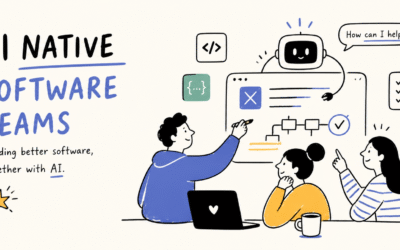
The primary challenge of this new era is no longer production capacity—it is product intent and decision-making speed. Many companies find themselves trapped in a talent gap where they lack the specialized expertise to move from a traditional “implementation unit” to a high-leverage digital factory where humans act as orchestrators of autonomous agent fleets. For a closer look at how this shift transforms daily workflows and delivery models, see our article on Building AI-Native Software Teams.
This shift requires more than just learning to use new tools; it requires building teams that can design, manage, and evolve the way humans and machines work together. Bridging this gap demands a strategic partner capable of rearchitecting roles, governance, and workflows to turn AI-driven speed into a durable competitive advantage.
In this article, we outline the essential AI skills and specialized roles development teams need to move beyond simple task assistance and successfully navigate the transition to an AI-native organization.
AI Skills in Demand (2026 Edition)
In the current landscape, the competitive differentiator has shifted from simply using AI tools to mastering the orchestration of agentic workflows within a stable organizational system. As software development moves toward a model where practitioners supervise a virtual organization of agents to achieve higher productivity gains, the following integrated skills and specialized roles are essential:
AI Architecture & Agentic Orchestration
Organizations are moving away from “plug-and-play” tools toward integrated, responsive AI designs that enable continuous value delivery.
- The AI Architect: A role seeing explosive growth as organizations rearchitect core systems for modularity and observability to support agentic scaling.
- Agentic Workflow Design: Beyond task assistance, this involves predefining the sequence of agent activities to ensure outputs are predictable and high-quality.
- Orchestration Management: Directing “orchestrator agents” that manage handoffs between specialized coding, testing, and security agents.
Cognitive Adaptability & Integrated Design Thinking
The interface between humans and machines is now a primary engineering discipline. This requires a shift from manual coding to systemic orchestration, where engineers leverage Adaptability and Product Thinking to move from writing every line of logic to directing agentic generation and validating architectural fit.
- Human-AI Collaboration Designers: A new class of professionals responsible for crafting seamless, intuitive interactions between people and intelligent systems.
- Strategic Directing: Engineers must leverage Adaptability and Product Thinking to move from writing every line of code to supervising generation and validating architecture.
- Gap Bridging (Vibe Coding): Using AI to bridge functional gaps, allowing developers to work across domains like databases or product management without deep prior manual expertise.
Intent-to-Task Decomposition & Context Engineering
As AI handles the “night shift” of execution, humans must master the translation of business intent into machine-ready “agent context”.
- Spec-Driven Development: Defining crisp, structured, and complete specifications that serve as the “ground truth” for agentic implementation.
- Contextualization: Feeding agents rich context—architecture diagrams, API contracts, and data models—using protocols like Model Context Protocol (MCP).
- Forward-Deployed Engineering: Bridging the gap between the business and IT by working directly with product teams to ensure technical execution matches high-level intent.
Critical Validation & Adaptive Governance
With AI generating massive volumes of code, humans act as “editors-in-chief” focused on risk and systemic integrity.
- Judgment-Based Review: Evaluating agentic decisions and assessing architectural fit to catch “architectural drift”.
- The Three M’s (Map, Measure, Monitor): Establishing governance that maps activities to intent, measures results against outcomes, and monitors real-time quality.
- Data Integrity Specialists: Experts ensuring that the synthetic or internal data fueling AI systems is trustworthy, representative, and free of bias.
AI Product Management
As the cost of producing code falls, the strategic value of the team shifts toward deciding what to build.
- High-Velocity Decision Making: Product leaders must develop a refined “gut” rooted in user empathy to make decisions at the same speed as agentic workflows.
- Spec-Driven Direction: Mastering the “authoring” of high-level intent. Translating business strategy into clear, structured requirements that ensure the AI builds the right thing for the user.
- Managing Performance Ambiguity: Utilizing tactical plans to navigate the inherent unpredictability of AI performance during early project stages.
- Rapid Prototyping: A rising expectation that product leaders can direct AI to build functional prototypes, validating ideas in days rather than months.
Efficiency & Value Stream Optimization
High-leverage systems require discipline to ensure that the increased speed of AI doesn’t lead to operational bottlenecks or waste.
- Resource Optimization: Monitoring the computational resources and tokens consumed by agents to ensure workflows remain cost-effective.
- Value Stream Management (VSM): Identifying and removing non-technical bottlenecks that might neutralize the speed gains provided by AI.
- Outcome-Based Tracking: Moving beyond simple adoption metrics to track real-world impact, such as release frequency and defect rates.
This optimization builds on the principles of Agile Teams, where independent work streams and clear team boundaries are designed to respond to feedback and deliver value at high velocity.
Krasamo’s AI Strategic Partnership: Transitioning to Agentic Orchestration
Krasamo offers more than just development services; we help with architectural decisions and provide the expertise to transition to AI-native operations.
Our team provides the skills to develop custom solutions based on your data systems, helping you move from traditional software development to orchestrating AI agents. We ensure you have the talent and structure to manage agentic workflows effectively.
This specialized approach builds upon our core logic for Software Team Formation, ensuring that the right roles and accountabilities are in place before execution begins.
- Build Scalable Foundations: Develop modular, observable architectures and POCs to ensure AI solutions are robust and ready for long-term growth.
- Upskill Through Co-Creation: Bridge expertise gaps by having your developers work alongside our specialists to master the orchestration of AI agents.
- Reduce Innovation Risk: Move from experimentation to core strategy with immediate access to advanced frameworks, governance, and Model Context Protocol (MCP).
Strategic Alignment of AI Skills
As AI skills are crucial for immediate implementation, organizations must align their talent development with long-term AI strategies. A comprehensive Generative AI Strategy can help businesses integrate these orchestration skills into a roadmap for sustainable growth and intelligent transformation.