





Table of Content
According to industry reports, back-office operations are among the most successful use cases for AI implementation, alongside areas like customer service and supply chain management, delivering tangible and measurable ROI for adopters.[1].
This shift is happening because AI has finally evolved to meet the challenge. Modern systems can more accurately process unstructured documents, interpret natural language, and perform advanced reasoning tasks to automate these core functions, capabilities that earlier technologies could only achieve in limited or rule-based forms.
As enterprises started experimenting with AI, they quickly realized it excelled at automating the structured, high-volume workflows characteristic of back-office functions. These early improvements led to a crucial insight: many tasks typically outsourced to Business Process Outsourcing (BPO) companies could now be automated in-house with greater efficiency. This provided a direct path to reducing external spend, with the resulting cost savings proving to be immediate and undeniably clear [2].
Many organizations adopting intelligent automation report achieving operational benefits beyond pilot projects. Back-office functions with intelligent automation are the key to unlocking immediate cost savings, building a more resilient operational foundation, and gaining a durable competitive advantage.
This article, part of our AI Use Case Series, provides a strategic overview for decision-makers exploring AI-driven innovations. It explores the core concepts of intelligent back-office automation and identifies the key opportunities for driving efficiency and gaining a competitive advantage.
What is Intelligent Automation?
Intelligent Automation (IA) is a strategic approach that represents the next evolution of business process management. It combines the rule-based foundation of traditional automation (like RPA) with the cognitive capabilities of modern Artificial Intelligence (AI) technologies, including Machine Learning (ML), Natural Language Processing (NLP), and Computer Vision.
While older automation was excellent at handling high-volume, repetitive tasks that followed strict rules, IA is designed to tackle the complex work that has historically required human judgment. The key capabilities that enable this leap include the ability to:
- Understand and Process Unstructured Data: Reading and interpreting the messy, human-generated content in emails, contracts, and scanned documents, areas where earlier rule-based automation could only extract surface-level text through OCR, without true contextual understanding.
- Make Nuanced Judgments: Handling complex, context-based decisions, such as identifying fraud risks or classifying customer sentiment, that go beyond simple rules.
- Orchestrate and Adapt: Coordinating entire end-to-end workflows and intelligently handling exceptions and new information. When paired with ongoing tuning or retraining, these systems can progressively improve performance over time.
By layering this intelligence onto business processes, organizations can move beyond simple task efficiency. They can begin to automate the complex, judgment-based functions that create true competitive advantage, freeing human employees to focus on more strategic and creative work.
What is Back-Office Automation?
The back office comprises all the critical, non-customer-facing functions that keep a business running. This includes departments like finance, accounting, human resources, IT operations, and compliance. Historically, these functions have been characterized by high-volume, manual, and often repetitive tasks. In a modern enterprise, this challenge is compounded by complexity, with the average company using dozens of different applications, leading to siloed data and fragmented processes.
Back-office automation is the strategic application of technology to reimagine and streamline these internal processes, a practice rooted in the foundational discipline of Business Process Management (BPM).
However, in the modern AI era, this definition has evolved. It’s no longer just about doing the same tasks faster. It’s about building intelligent automations that can:
- Orchestrate complex, multi-step workflows from end to end.
- Understand and process unstructured data (like emails, PDFs, and scanned documents) that earlier rule-based or OCR-driven systems could only extract from, but struggled to interpret reliably at scale.
- Make judgments and handle exceptions based on learned context.
- Adapt and improve through ongoing tuning and experience, becoming more efficient over time
Ultimately, modern back-office automation is about transforming these traditional “cost centers” into highly efficient, data-driven engines that free up human talent to focus on strategic, high-value work.
The strategic value of this transformation can be realized in two powerful ways. For companies relying on external vendors, it presents a direct opportunity to reduce resilience spend on Business Process Outsourcing (BPO) contracts. For those with in-house teams, the value comes from creating operational leverage, augmenting their skilled workforce and enabling the business to scale without a proportional increase in headcount
Core Tasks Involved in Back-Office Operations
The scope of the back office is vast, but a few key areas have emerged as prime candidates for AI-powered automation. This is because these functions, traditionally defined by high volumes of repetitive work, rely on capabilities where modern AI excels, such as processing unstructured documents, data extraction, and complex reasoning.
Finance and Accounting:
- Invoice processing and accounts payable/receivable
- Expense report auditing and compliance checks
- Financial reconciliation and closing processes
- Contract analytics and lifecycle management
Human Resources:
- Employee onboarding and offboarding workflows
- Payroll processing and benefits administration
- Resume screening and candidate tracking
Customer Support Operations:
- Ticket triage, categorization, and routing
- Knowledge base management and response generation
- Compliance monitoring and quality assurance reporting
A Brief Evolution of Back-Office Automation
The journey to an intelligent back office has been a multi-decade evolution, with each stage building on the last while revealing new limitations.
1. Manual Processing: The original state, characterized by paper-based systems, physical filing, and extensive manual data entry. This was incredibly labor-intensive, slow, and prone to human error.
2. Early Digitization (The ERP Era): The widespread adoption of Enterprise Resource Planning (ERP) systems in the 1990s marked the first major leap toward centralized digital operations. These systems centralized data but still required significant manual input to bridge gaps between departments or convert physical documents into digital workflows.
3. Robotic Process Automation (RPA): The Dependable Foundation Screen scraping and basic automation tools appeared in the 2000s, but RPA as a category and mainstream enterprise adoption took off in the mid-2010s. This technology uses software “bots” to mimic human keystrokes and mouse clicks, creating a digital workforce that can execute high-volume, rules-based tasks.
The power of RPA lies in its dependability, structure, and control. For many enterprises, it has become the essential foundation for process optimization, particularly for its ability to provide systems integration with legacy applications that lack modern APIs. In this role, RPA acts as the reliable “hands and feet,” pulling data from old systems or entering information into them with precision.
However, RPA’s strengths are also its limitations. It is often brittle, if a website button changes, the bot breaks. More fundamentally, it automates a task, but it cannot truly understand the underlying process. It cannot handle unstructured data, make nuanced decisions, or adapt to exceptions.
4. The Convergence of RPA and AI: Creating a Complete Solution
Recognizing the limitations of RPA, the most forward-thinking organizations are now pursuing a strategy of convergence. This model combines the strengths of both technologies to create a complete, end-to-end automation solution that is both resilient and intelligent.
In this model:
- RPA continues its role as the dependable foundation, handling the structured, repetitive tasks and acting as the bridge to legacy systems.
- AI is layered on top as the “intelligence engine,” handling the complex parts of the workflow, interpreting unstructured documents, making judgments, and managing exceptions. This convergence allows businesses to leverage their existing RPA investments while elevating their automation capabilities to a new level [3].
5. The Agentic AI Leap (Today): We are now in the most transformative stage. Agentic AI, an emerging concept, is seen by many as a paradigm shift. These systems go beyond mimicking clicks by aiming to understand the intent behind a process. They can read and interpret unstructured invoices, handle complex exceptions that would break an RPA bot, and orchestrate entire end-to-end workflows that require reasoning and context. This is the leap from automating simple tasks to automating complex business functions. This transformation is powered by a modern data-to-AI platform, which provides the foundation for turning raw, unstructured business information into intelligent, automated action.
Business Automation Platform: Your Foundation for Success
As a core component of any modern digital transformation strategy, intelligent back-office automation is an essential discipline for creating value. However, achieving success at scale requires more than just innovative AI models; it demands an essential foundation: a modern business automation platform. This platform is the central nervous system that enables you to move beyond isolated projects and build a true, enterprise-wide automation capability.
According to leading industry analysts, a truly modern platform is defined by its ability to provide five core capabilities:
- Model Management: The flexibility to integrate with and manage a wide variety of AI models (from different vendors or open source) in a controlled, secure, and cost-optimized way.
- Advanced Content Processing: The ability to handle the full spectrum of enterprise data, from extracting information from massive, complex documents and forms to processing real-time streaming data.
- AI Agent Creation: A built-in “breeding ground” for developing, testing, and deploying robust AI agents that can handle complex, long-running business processes.
- Agentic Orchestration: A powerful engine to coordinate the complex blend of AI agents, RPA bots, human experts, and various software systems across an end-to-end workflow.
- Unified Governance and Security: A single, consistent framework for ensuring that all automations are secure, compliant, and that your enterprise data and intellectual property are protected.
Ultimately, embracing a platform-based approach is a critical strategic shift. It is the architectural foundation that allows a business to harness the power of AI in a secure, governed, and scalable way, transforming back-office operations into a source of lasting competitive advantage.
The Core of Modern Automation: Agentic Workflows and Multi-Agent Systems
At the heart of intelligent automation lies the agentic workflow. Unlike most recent AI applications that focus on single-prompt outputs, agentic systems emphasize self-directed, iterative problem-solving. This workflow empowers a single AI agent to execute a sophisticated, multi-stage process to achieve a goal.
This process typically involves several key capabilities:
- Planning: The agent can then take this grounded information and break a large problem down into a logical sequence of smaller, manageable steps.
- Tool Use (also called “function calling”): To execute those steps, the agent can use “tools” to interact with other systems, such as accessing a database, querying a CRM, or updating an ERP.
- Reflection: Finally, the agent can review its own work, identify potential errors, and refine the output, much like a human expert revising a draft.
While a single, powerful agent can accomplish a great deal, the most complex and robust back-office automations are often handled by a more advanced architecture: a multi-agent system.
This approach creates a digital “team of specialists.” Rather than relying on one generalist agent, a multi-agent system orchestrates several specialized agents to collaborate on a goal. For example:
- A Retrieval Agent might be an expert at querying your internal databases for customer data.
- A Planning Agent could then take that data and outline the steps for a complex financial reconciliation.
- An Action Agent would execute the final steps, such as updating your ERP system or sending a notification.
By collaborating and handing off work, this team of agents achieves a level of sophistication and reliability that a single agent often cannot. Understanding how to design and orchestrate these collaborative AI teams is a crucial discipline in modern application development.
To explore the architectural patterns and key components of these advanced systems, read our in-depth paper: [Multi-Agent Systems 101].
Behind the Scenes: How a Multi-Agent Workflow Creates a Promotional Film
To bring the concept of agentic workflows to life, let’s consider a practical example from the world of film production.
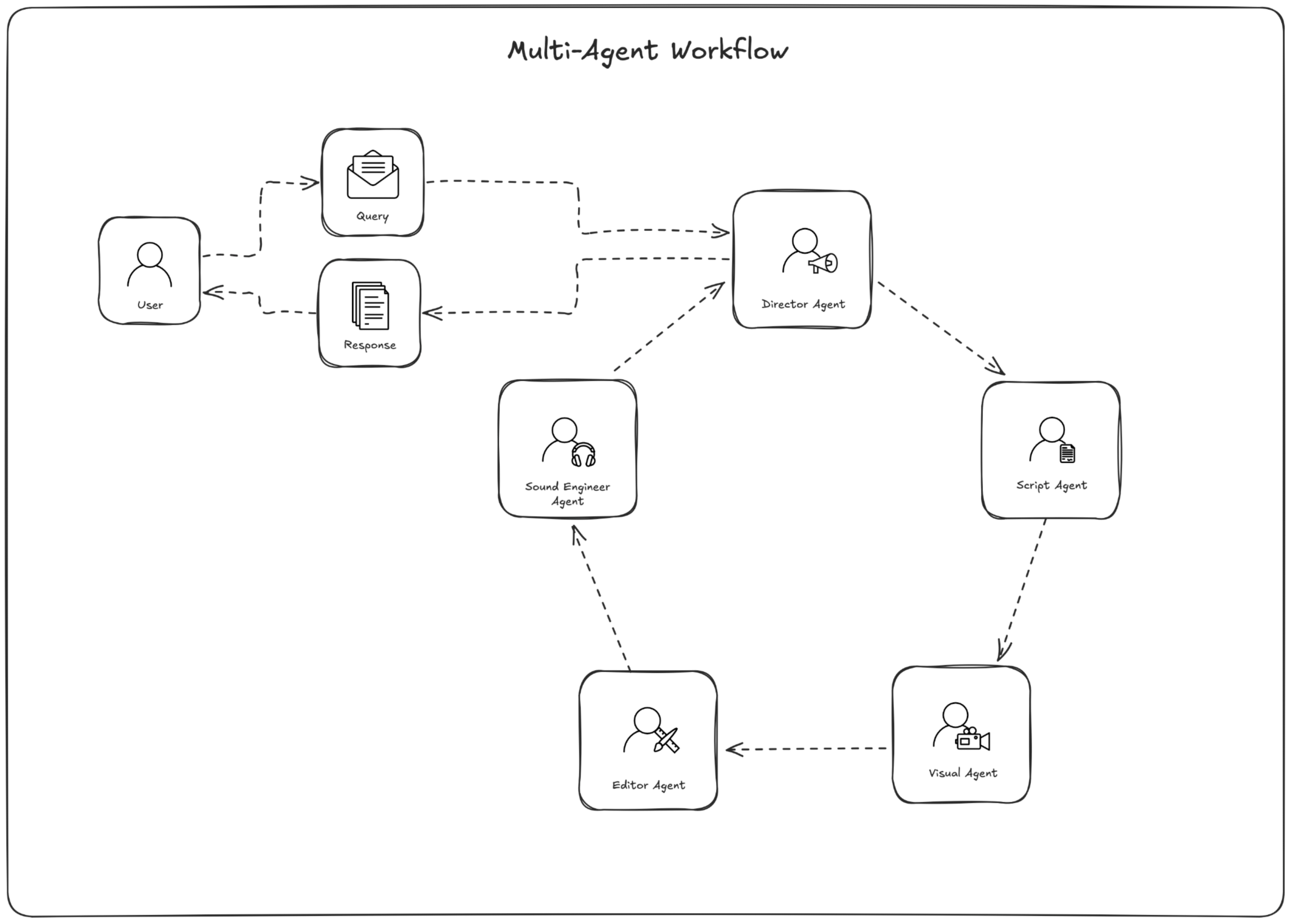
Figure 1 illustrates a multi-agent workflow where a Producer (the user) requests a short promotional video. The Director Agent acts as a coordinator, interpreting the request and assigning tasks to specialized agents. The Script Agent drafts the narrative and dialogue, while the Visual Agent generates scenes or selects relevant footage. The Audio Agent handles background music and voice-overs, and the Editor Agent combines these elements into a cohesive video. Finally, the Director Agent reviews the output, makes necessary adjustments, and delivers the finished version to the Producer.
This workflow shows how multiple AI agents, each with a specific capability, can collaborate to achieve a common goal, in this case, producing a promotional video. Each agent handles a focused task, such as writing, generating visuals, or editing content. Through structured coordination and information sharing, the agents work together to turn the producer’s request into a complete and coherent final product.
Ready to Transform Your Back-Office Operations?
Moving from theory to a successful, enterprise-grade AI implementation requires a partner with deep expertise in both strategy and execution. At Krasamo, we design and build the intelligent automation solutions that deliver real, measurable business value.
Explore our AI Development Services to learn more about our process and how we can help you build your competitive advantage.
References:
[1] The GenAI Divide: STATE OF AI IN BUSINESS 2025, MIT NANDA
[2] Unbundling the BPO: How AI Will Disrupt Outsourced Work, a16z
[3] Why Financial Services Must Converge AI and RPA Investments Now, UiPath



Good topic! It’s very important to have this kind of automation nowadays.
I agree with you! I enjoyed how the author breaks down the evolution from traditional RPA to modern intelligent automation that can interpret unstructured data and handle complex workflows. I learned clearly isn’t just about improving efficiency but enabling businesses to transform back-office functions into strategic assets and free up teams for different qualifications (to not say upper with value hehe). This perspective on agentic workflows and multi-agent systems was especially insightful and helps illustrate how advanced automation can function in real scenarios. Thanks for sharing!
I completely agree with the author’s perspective on back-office automation! As an AI engineer, I’ve seen firsthand how intelligent automations can revolutionize internal processes. AI development services have become increasingly sophisticated, enabling us to create systems that not only automate tasks but also learn and improve over time. This evolution is exactly what we need to unlock true efficiency gains in our organizations!
I completely agree that moving beyond simple task efficiency is where Intelligent Automation truly shines! By leveraging advanced AI techniques such as Transfer Learning in LLM application development, we can create systems that not only adapt to new information but also learn from experience. This enables organizations to automate complex judgment-based functions and unlock strategic value.
I completely concur with the blog post’s overview of back-office automation evolution! The adoption of RPA has been a game-changer for many organizations. As an AI engineer, I’d like to emphasize the importance of integrating Large Language Model (LLM) application development into the next stage of intelligent back-office operations. This will enable more sophisticated knowledge base management and response generation capabilities.
Thanks for shedding light on the paradigm shift that is Intelligent Automation! I wholeheartedly agree that IA is not just a evolution of BPM, but rather a game-changer that leverages cognitive capabilities like ML and NLP to tackle complex tasks. The ability to understand unstructured data is indeed a massive leap forward – it’s going to be fascinating to see how this technology transforms industries and drives efficiency!
I’m loving this post! You’re absolutely right about the convergence of RPA and AI in back-office operations. With the rise of Large Language Model (LLM) application development, we can now build more sophisticated agentic AI systems that truly understand business processes and intent. This is indeed a game-changer for automating complex workflows and elevating automation capabilities. Thanks for shedding light on this exciting space!
I thoroughly enjoyed reading your thought-provoking post on implementing intelligent automation in back-office operations! The emphasis on a modern business automation platform as the central foundation is spot on. I’d like to add that a well-designed platform should also prioritize seamless integration with existing systems, facilitating end-to-end process digitization and thus unlocking the full potential of back-office automation.