




Table Of Content
Why You Should Learn to Develop IoT
Entering IoT software development can feel challenging due to the sheer volume of information available. The IoT market is massive, fragmented, and composed of diverse niches, each serving a specific purpose. This ecosystem involves a wide array of chips and components, each associated with different brands and specialized coding tools. To succeed, you must select a hardware path, master it, and grow with the ecosystem.
This journey requires an Integrated Development Environment (IDE), a firmware tool that allows developers to write, edit, test, and package software efficiently. For both individual developers and enterprises, the right IDE is what transforms a conceptual IoT product into a functional reality.
The Role of IDEs in IoT
The Internet of Things (IoT) refers to a network of interconnected devices that collect, share, and act on data via the Internet. These devices include sensors, wearables, and industrial appliances, all of which enable automation and complex system functionalities. Developing these solutions is a demanding task that requires specialized IDEs. These tools provide the necessary support for communication protocols and hardware integration, making them essential for building and managing the lifecycle of an IoT application.
IoT development represents both the present and future of the global job market. For both entry-level programmers and seasoned developers, mastering this field is a strategic career move. The adoption of IoT devices has seen exponential growth; according to Allied Market Research [1], the IoT market is projected to reach 5,332.3 billion dollars by 2032. As IoT is applied across all industrial sectors, companies are aggressively expanding their programming teams to create new solutions, which opens significant opportunities for developers. Furthermore, IoT knowledge is beneficial for maintaining smaller, localized projects using off-the-shelf products.
Developing IoT software does not always require proprietary or expensive tools. You can start with free environments like the Arduino IDE, which is excellent for learning. It even supports device simulations, allowing you to test logic without physical hardware. However, learning directly from the hardware source is recommended. Working with a device like the ESP32 enables you to understand and solve the real-world challenges of IoT development.
IoT Characteristics and Advantages for Developers
To begin programming, you must understand the foundational languages of the industry. C and C++ remain the most predominant languages, as they are used to create compact, optimized firmware for the small, low-power devices that make up the bulk of the market.
Other languages serve specific roles within the stack. Go is increasingly used for edge gateways and systems that require high-performance concurrency with a smaller footprint than Java. Python is the standard for edge devices that manage multiple data streams or perform local data analysis. While other languages exist in this space, these three are the most relevant for modern IoT development.
Another critical factor is cloud management. IoT devices typically interact with servers, whether personal or enterprise-grade. While deep familiarity with AWS, Azure, or Google Cloud is not strictly required for firmware-only roles, understanding these services is essential for professional growth and system-level development.
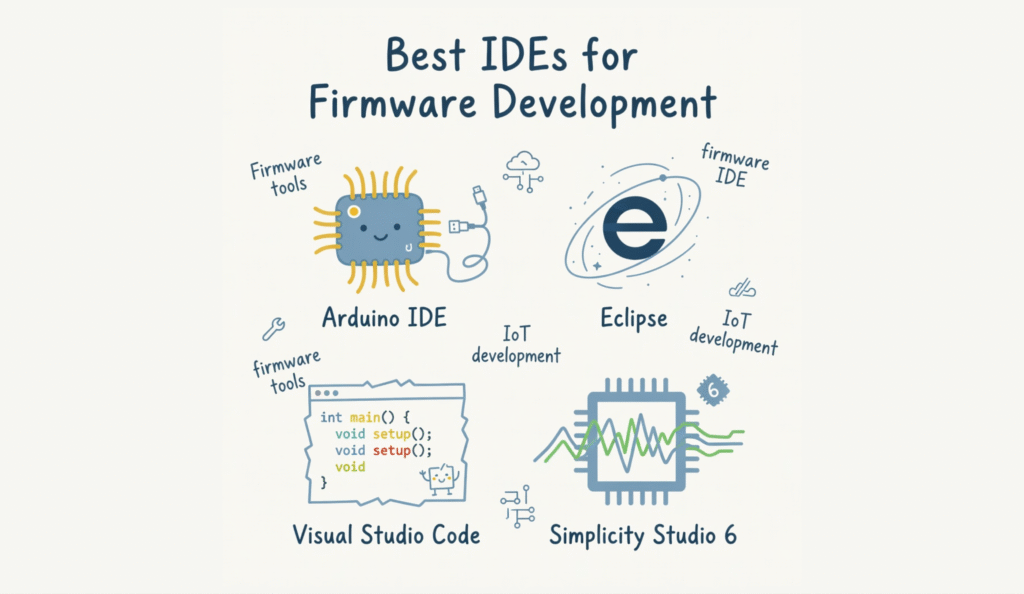
The IDEs mentioned in this article are our recommended options based on professional experience. We recognize that this list is not exhaustive and that individual preferences vary. The following environments are used by our developers across various projects and are listed from least to most complex.
Best IDEs for IoT Development
Arduino IDE
The Arduino IDE is the ideal starting point for beginners. It features a clean, simple interface that avoids confusing menus, providing an intuitive blank space for experimentation. It uses a simplified version of C++, making it accessible even if you are not an expert. The massive community surrounding Arduino ensures that tutorials, forums, and libraries are always available to help you troubleshoot.
Arduino IDE is accessible, practical, and designed for experimentation and learning without feeling lost. It’s the perfect tool for taking your first steps in programming and seeing your ideas come to life.
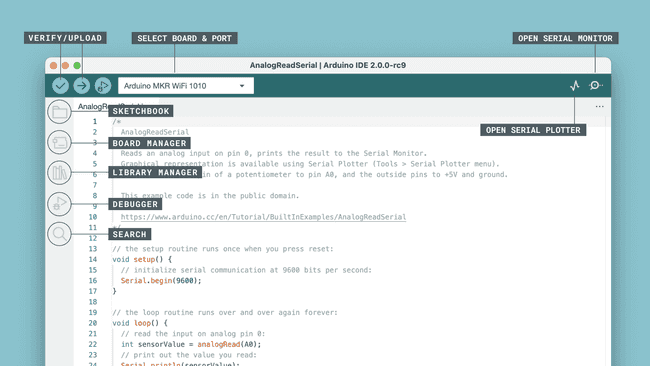
IoT Development IDE: Arduino IDE
Eclipse
In professional firmware engineering, the Eclipse CDT (C/C++ Development Tooling) serves as an indispensable industrial engine for toolchain orchestration. While “lightweight” editors often trend in high-level software circles, the reality of bare-metal development requires a deterministic environment capable of managing the complex cross-compilation demands of fragmented ARM Cortex-M and RISC-V architectures. This technical maturity is why semiconductor leaders, such as STMicroelectronics, NXP, and Renesas, build their vendor-specific derivatives (including STM32CubeIDE and MCUXpresso) on the proven Eclipse framework. By utilizing Eclipse as the underlying plumbing, these manufacturers provide a stable workspace where sophisticated linker scripts and HAL generators remain reliable as the codebase scales to production.
When isolating a race condition or a stack overflow on a production-grade gateway, a standard text editor is a functional liability; one requires the heavyweight infrastructure of the Eclipse debugging perspective. The platform integration with JTAG/SWD debug probes facilitates a level of real-time register visibility and memory analysis that is non-negotiable for verifying silicon behavior. The strategic advantage for the IoT architect lies in the ability to bridge the gap between low-level bit manipulation and high-level system telemetry within a singular workspace.
The Eclipse framework provides deep visibility into peripheral registers and memory states, enabling precise hardware-level troubleshooting. Its seamless integration with the Energy Profiler allows you to correlate power consumption directly with specific lines of code to maximize battery efficiency.
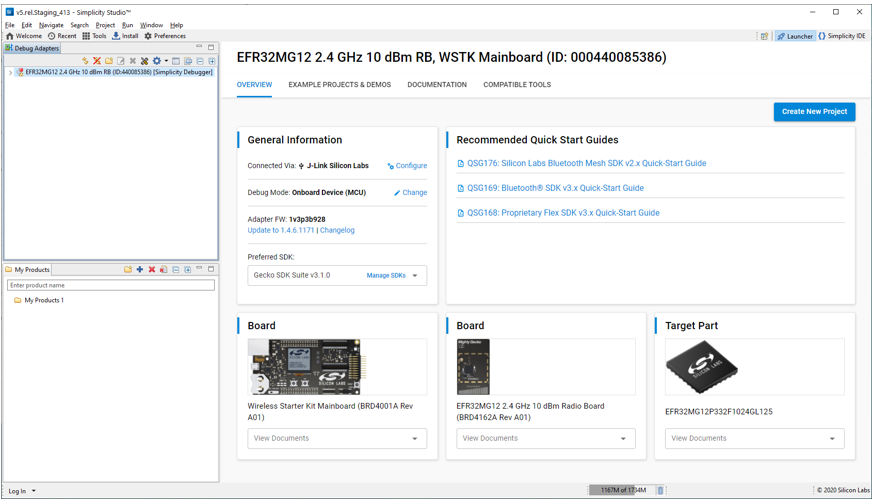
Simplicity Studio 5 Dashboard based on Eclipse from Silabs web page
Visual Studio Code
Visual Studio Code (VS Code) may be one of the best firmware tools for beginners because it combines power with simplicity, all wrapped in a modern and user-friendly interface. From the moment you install it, you feel like you have a very professional software in your hands, but without intimidation.
While the Eclipse IDE remains the cornerstone for deep-tier firmware development, the industry is witnessing a strategic evolution with the rise of Visual Studio Code (VS Code) as a high-velocity orchestration layer. For many engineers, VS Code is no longer just a “beginner’s tool” or a lightweight editor; it has matured into a sophisticated environment that balances modern interface agility with professional-grade performance. This shift is best exemplified by the recent launch of Simplicity Studio 6 [2], where Silicon Labs has moved to leverage VS Code as a primary development environment. This integration allows teams to move away from the traditional, often cumbersome IDE overhead while maintaining full access to vendor-specific SDKs and hardware configuration tools. It represents a pivot toward a more modular toolchain, where the same environment used for high-level application logic now handles professional embedded targets with industrial precision.
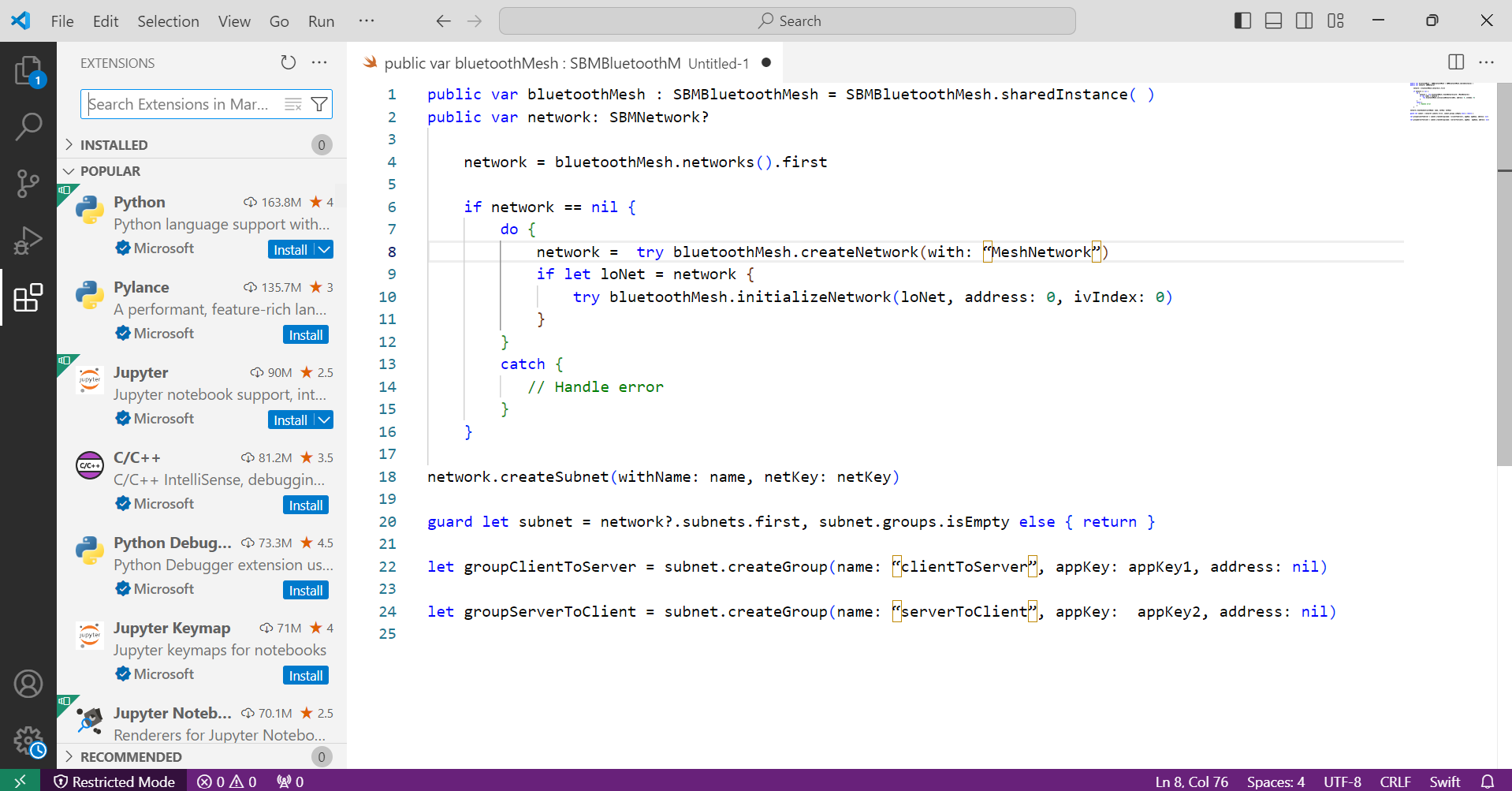
IoT Development IDE: Visual Studio Code Dashboard
Simplicity Studio 6
Silicon Labs has redefined the developer experience with Simplicity Studio 6 (SS6). Moving beyond a monolithic IDE, SS6 offers a flexible, toolchain-agnostic ecosystem. For the hardware architect, the most significant shift is the formal integration with Visual Studio Code, allowing engineers to leverage professional Silicon Labs SDKs and configuration tools within a more modern, high-velocity workspace. This update preserves the “out-of-the-box” hardware recognition that defined earlier versions, instantly surfacing relevant code examples and documentation upon connection; while stripping away the friction of rigid, vendor-locked environments. By supporting both the legacy Eclipse-based environment and the new VS Code extension, SS6 provides a seamless transition for teams looking to modernize their firmware workflows without sacrificing access to critical low-level tools.
In the context of the production IoT stack, Simplicity Studio 6 excels in managing the complexity of multi-protocol environments, including Matter, Zigbee, Thread, and Bluetooth Low Energy. The platform provides a sophisticated graphical interface for hardware orchestration, allowing for the precise configuration of peripherals, pin-mapping, and clock trees through the “Pin Tool” and “Project Configurator.” However, the “killer feature” for battery-constrained IoT devices remains the Advanced Energy Monitor (AEM) and the Network Analyzer. These tools allow for real-time correlation between code execution and current consumption, enabling engineers to hunt down energy spikes and optimize firmware for years of field operation. By consolidating these high-tier diagnostic capabilities into a unified, modular framework, Simplicity Studio 6 serves as a critical bridge between the physical silicon and the high-level application layer.
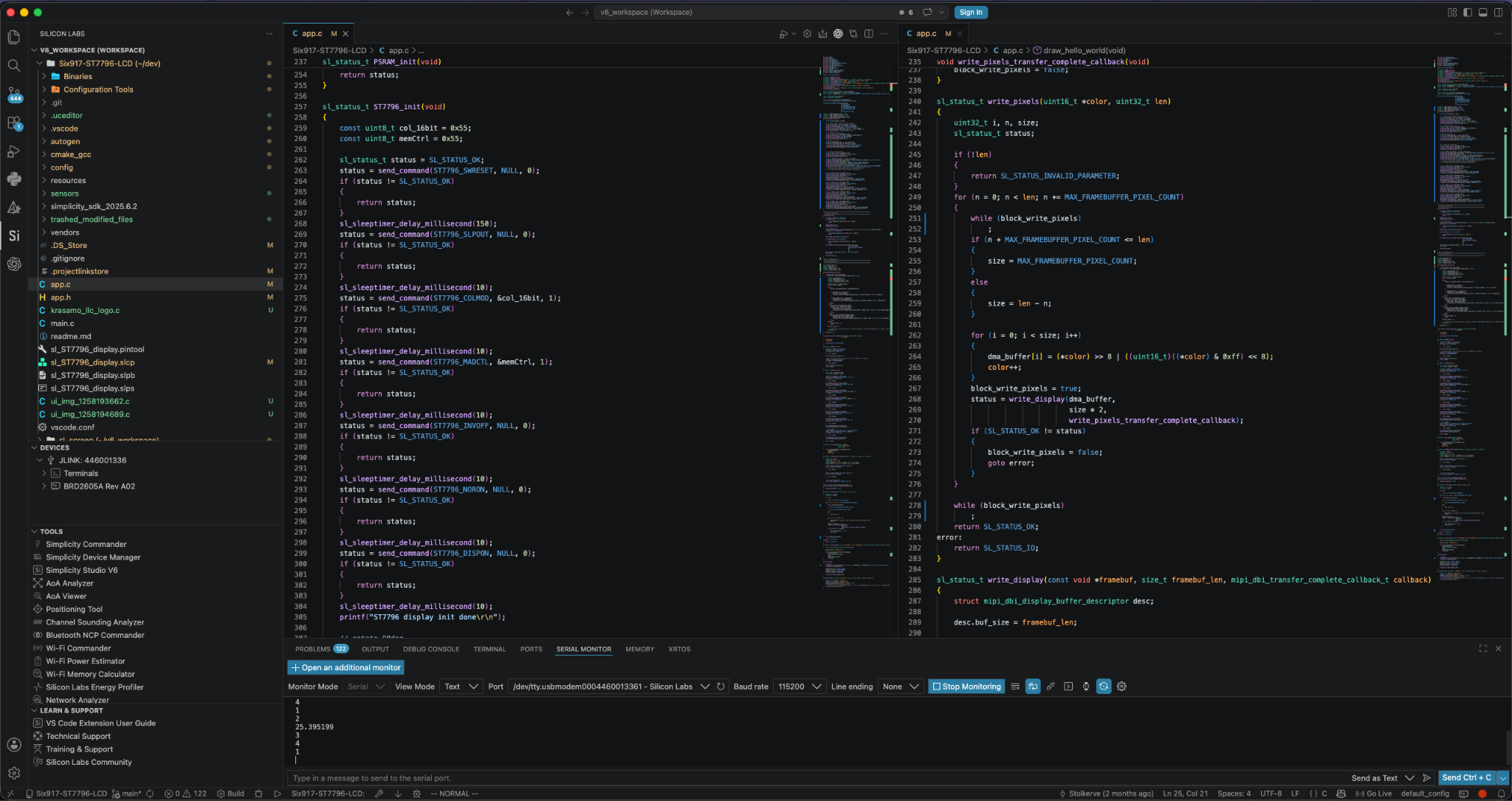
IoT Development IDE: Visual Studio Code Dashboard with Simplicity 6 Studio Plugin
Moving Forward with Simplicity Studio 6 and the SiWx917
At Krasamo, our engineering philosophy is built on high-volume, production-hardened reliability. A primary milestone in our history is the Lennox S40 series, a premier smart thermostat platform. By utilizing the deterministic build environments of Simplicity Studio 5, we delivered a market-leading product that surpassed the one-million-unit mark. This achievement was made possible by the rigorous toolchain orchestration provided by Silicon Labs, ensuring field stability for a tier-one consumer product.
Building on that legacy, we are currently spearheading a new project centered on the Silicon Labs SiWx917, an ultra-low-power Wi-Fi 6. Central to this efficiency is the WiseConnect 3 SDK, the foundational software framework that allows developers to implement Wi-Fi 6 and Bluetooth LE 5.4 connectivity with minimal overhead, designed for the next generation of battery-constrained IoT devices. Developing for the SiWx917 requires managing a complex dual-core architecture and a high-performance wireless stack, which is why we have transitioned to Simplicity Studio 6 as our primary development engine. A key force multiplier in this version is the formal VS Code integration. For Krasamo, this represents a significant “quality of life” upgrade; it provides our engineers with the agility of a modern, polyglot editor while maintaining the deep-tier register visibility and hardware-specific configuration tools that professional firmware development demands.
Bridging Diversity and Precision
The move to Simplicity Studio 6 signifies Krasamo’s commitment to developer diversity and toolchain evolution. By leveraging the new VS Code extensions, we are able to bridge the gap between low-level bit manipulation and high-level application logic within a singular, efficient workspace. This unified environment reduces the friction often associated with vendor-specific derivatives, allowing our team to focus on what matters: pushing the boundaries of ultra-low-power connectivity on the SiWx917. We are not just building for the present; we are optimizing for a future where hardware-level precision and software-level agility coexist seamlessly.
Krasamo is a firmware development company and it has experienced IoT engineers that can bring you a solution for all of your necessities.