02
Objectives
Implement a unified phone and web AI assistant on Wildix to capture leads and answer prospective students’ questions about plans, pricing, and policies 24/7.
03
Challenges
One of the central challenges in this project was designing an agent capable of reliably handling business-sensitive information related to driving lesson plans, pricing, and school policies. Because the assistant was intended to operate across phone and web channels and serve prospective students around the clock, it needed to deliver fast, consistent, and accurate responses without creating commercial or reputational risk for the client. In this context, even small inaccuracies in pricing or policy communication could lead to confusion, misaligned expectations, or loss of trust.
This challenge was compounded by the nature of the source material itself. The original service and pricing information was extensive, repetitive, and structurally complex, making it difficult to translate directly into a form that an AI assistant could use with confidence and precision. Without careful preparation, the agent could misinterpret overlapping service descriptions, surface outdated or irrelevant details, or respond ambiguously when faced with similar offerings.
Edge-case user behavior also presented a significant risk. Since the assistant was responsible for answering pricing-related questions, it had to remain controlled when users attempted to negotiate discounts, request exceptions, or ask about services not explicitly covered in its knowledge base. In such cases, an insufficiently governed model could hallucinate, improvise unauthorized offers, or provide answers that fell outside approved business rules. Ensuring the assistant stayed accurate, bounded, and commercially safe under adversarial or ambiguous prompting was therefore a critical requirement.
Another obstacle was creating a conversational intake experience that worked effectively across voice and chat channels. Once a prospective student expressed clear interest in enrolling, the assistant needed to gather contact details for follow-up. While this may appear straightforward in a text interface, collecting information such as names and phone numbers over a live phone call introduces additional friction. Callers may speak quickly, provide incomplete responses, change their minds mid-conversation, or share information in a format that is difficult for the system to capture reliably. The experience therefore had to balance efficiency with a natural conversational flow, ensuring that the process remained accurate without feeling mechanical or repetitive.
Lastly, testing the agent thoroughly through manual review alone presented a practical challenge. The system had to be evaluated against standard customer questions, unexpected edge cases, and adversarial interactions designed to expose weaknesses in prompt behavior, knowledge boundaries, and intake logic. Conducting this level of testing manually across multi-turn conversations would have been time-intensive, inconsistent, and difficult to scale, especially for a solution expected to operate continuously in a customer-facing environment.
04
Solutions
To address the complexity and sensitivity of the assistant’s role, the implementation began with a prompt engineering strategy designed to constrain the model’s behavior and keep responses aligned with approved business rules. Special attention was given to how the agent should communicate pricing, policies, and service boundaries, including how it should respond when users asked unsupported questions or attempted to negotiate beyond authorized terms. This helped create a more controlled conversational experience and reduced the likelihood of speculative or non-compliant answers.
In parallel, the underlying knowledge base was simplified and refined to make it more usable for the AI agent. Redundant and overly complex service information was consolidated into a clearer, more structured format, enabling the assistant to retrieve and present information with greater consistency. By reducing ambiguity in the source content, the solution improved answer quality while making the system easier to govern and maintain over time.
Given the commercial sensitivity of pricing-related interactions, the assistant was tested extensively in a sandbox environment before release. This allowed the team to simulate realistic user journeys and validate how the agent behaved under a wide range of scenarios without introducing risk to live operations. The isolated testing approach ensured that business logic, answer quality, and escalation boundaries could be verified safely before production deployment.
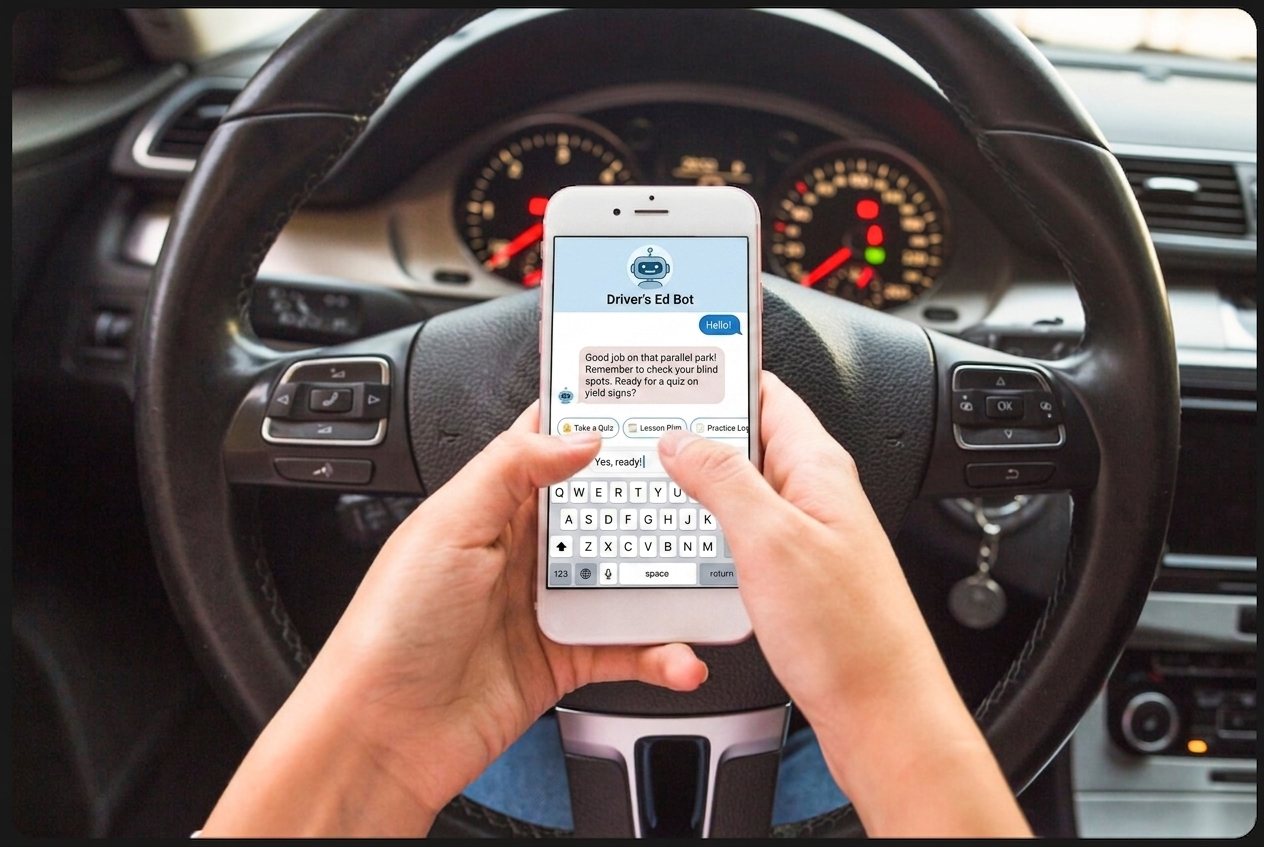
For the conversational intake workflow, prompt engineering again played a critical role in shaping how the assistant collected lead information. The conversation flow was designed to guide interested prospects naturally toward sharing their details while keeping the exchange simple and user-friendly. Because voice-based data capture is particularly sensitive to misinterpretation, rigorous testing was used to improve how the assistant requested, confirmed, and recorded contact information. This ensured a smoother handoff from initial inquiry to follow-up, allowing the driving school to capture more qualified leads without placing additional burden on staff.
To overcome the limitations of manual testing and further strengthen reliability, adversarial evaluation was conducted using the DeepEval framework. Automated Red Teaming focused on multi-turn conversations involving business data such as pricing and service information. The testing approach combined human-curated and LLM-generated test cases, an LLM User Simulator to reproduce realistic and edge-case behaviors, and an LLM-as-a-Judge methodology to assess response quality and policy adherence at scale. This evaluation process helped identify vulnerabilities early, refine the assistant’s behavior, and improve confidence in its readiness for customer-facing use.
We'd love to hear from you!
Drop us a message, and let’s start creating something amazing together.